
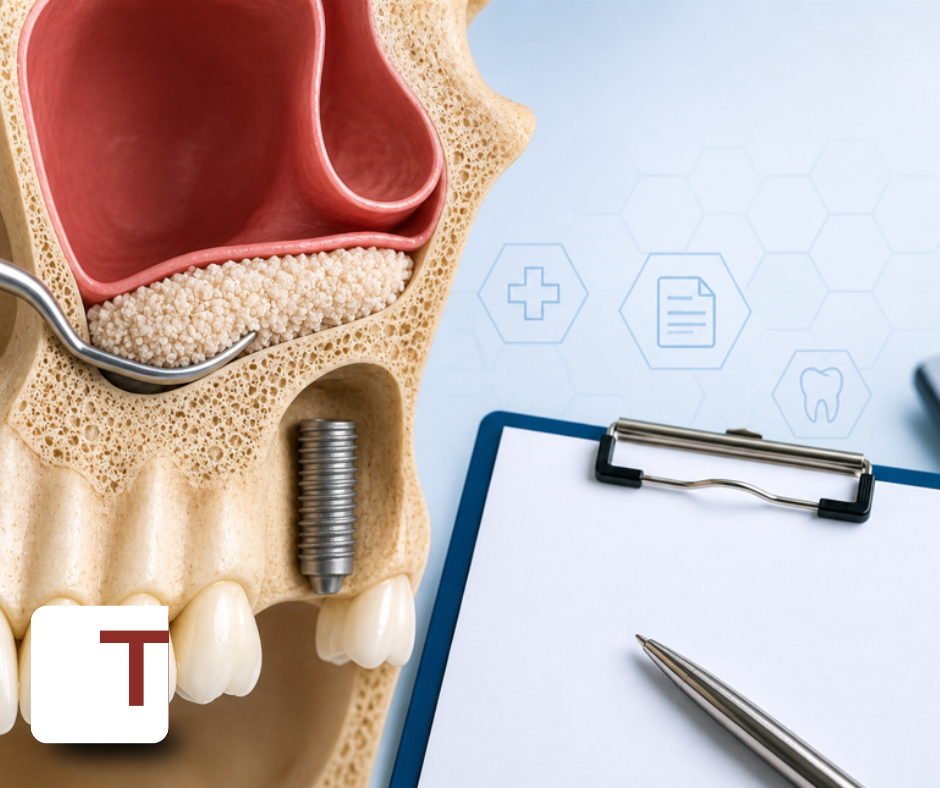
Introducing medical billing into a dental office requires more than simply adding new codes—it needs a clear understanding of how clinical documentation, dental coding, and medical necessity work together. Procedures such as sinus augmentation (sinus lift) sit at the intersection of dental and medical billing, making accuracy from the outset essential for proper reimbursement and compliance.
Success commences with documentation. The clinical record must clearly document not only the procedure performed, but also why it was necessary and how it was completed. When documentation and coding align, practices are more likely to reduce denials, support medical necessity, and streamline reimbursement.
Reporting a sinus augmentation begins by confirming the surgical approach and ensuring the clinical record supports that choice. In CDT coding, approach matters:
- D7951 — Sinus augmentation with bone or bone substitutes via a lateral open approach
- D7952 — Sinus augmentation via a vertical approach
Your documentation should clearly describe:
- The surgical technique used
- The site and laterality
- The clinical indication for the procedure
- The materials used (bone and/or bone substitutes)
- Any graft handling or fixation details, when applicable
Equally important is documenting the purpose of the procedure. Sinus augmentation is performed to increase available bone in the posterior maxilla, where the sinus limits the ability to place dental implants. Clearly stating this intent helps establish the clinical rationale behind the procedure.
Taking the time to ensure the operative note reflects the full procedure—and corresponds to the selected code descriptor—lowers the chance of denials and supports future record requests.
Dental Coding: Pairing the Procedure to the Descriptor
Once the approach and clinical intent are verified, selecting the appropriate CDT code gets straightforward. The key is to align the procedure performed with the full code descriptor, rather than relying on assumptions.
Careful code selection:
- Supports accurate claim submission
- Reduces requests for extra documentation
- Helps establish harmony across patient records
This focus on detail immediately saves valuable time later in the revenue cycle.
When Medical Billing May Apply
In some cases, dental benefits may not cover sinus augmentation. When this occurs, medical billing may be appropriate—provided the procedure meets medical necessity requirements.
Medical necessity is typically defined as services required to diagnose or treat a condition, disease, or its symptoms, in accordance with accepted standards of care. For sinus augmentation, this means the documentation must clearly connect the procedure to a medical condition or functional impairment, not solely implant placement.
Examples of conditions that may support medical necessity include:
- Significant bone loss due to trauma or pathology
- Congenital deformities affecting the maxilla
- Functional limitations related to oral or facial structure
The clinical narrative plays a critical role in establishing this connection.
ICD-10 Coding: Supporting Medical Necessity
Diagnosis coding should reflect the underlying condition that justifies the procedure. Rather than selecting broad or unspecified codes, choose the most accurate diagnosis based on the patient’s clinical presentation.
Examples may include conditions within:
- Dentofacial anomalies (malocclusion and structural abnormalities)
- Maxillary or alveolar defects
- Congenital deformities of the skull and facial structures
Accurate diagnosis coding strengthens the claim by clearly linking the procedure to a documented medical condition.
CPT Coding: Translating to Medical Claims
When billing medical insurance, the procedure must be reported using the appropriate CPT code that reflects the surgical service performed.
One commonly applicable code is:
- 21210 — Graft, bone; nasal, maxillary, or malar areas
This code may be appropriate when the sinus augmentation involves bone grafting in the maxillary region. As with all medical billing, the operative report must clearly describe the procedure in phrases consistent with the CPT descriptor.
Insufficient or ambiguous documentation can lead to denials, even when the procedure itself is appropriate for medical billing.
Bringing Everything Together
Sinus augmentation is a procedure where documentation, dental coding, and medical billing intersect. Each component must support the others:
- The clinical record establishes the “what” and “why.”
- CDT coding reflects the dental procedure performed
- ICD-10 and CPT coding support medical necessity and reimbursement
When these parts are aligned, practices are better equipped to:
- Reduce claim denials
- Respond to payer requests swiftly.
- Expand reimbursement opportunities when appropriate.
Building a firm foundation in documentation and coding improves financial outcomes and creates a more confident and efficient workflow for the entire team.
About the Author
Christine Taxin is the founder and president of Links2Success, a practice management consulting company in the dental and medical fields. With over 25 years of experience as a practice management professional, she now provides private practice consulting services and delivers continuing education seminars for dental and medical professionals.
FMI: www.links2success.biz or 914-303-6464
Read more from Christine Taxin:

Trojan Today | Medical Billing in Your Dental Practice Pt 1
Trojan Today | Medical Billing in Your Practice Pt 2
Trojan Today | TREATMENT NOTES: An Essential Part of Exceptional Care
Follow this link for Links2Success’ endo book & use code TROJANTODAY for $25 off: https://dentalmedicalbilling.com/product/endodontics/